
Language Tips for Dating Filipinas: Why a Little Helps
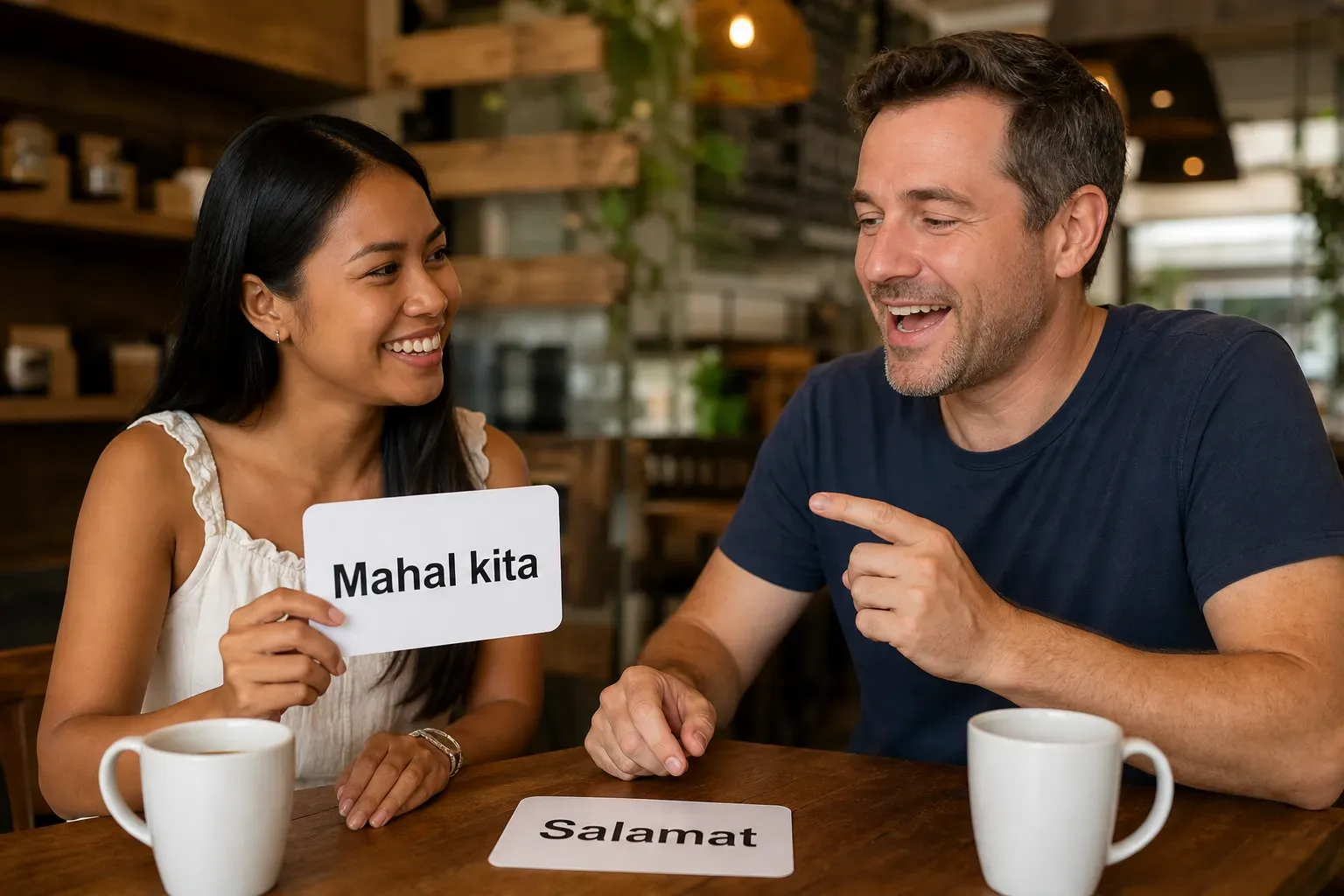
Language tips for dating Filipinas start with good news: you do not need to learn Tagalog to date a Filipina. The Philippines has one of the highest English-proficiency rates in Asia, and your conversations will mostly happen in English or Taglish — a natural mix of Tagalog and English. But making the effort to use a few phrases signals respect for her culture, and that effort is noticed and appreciated far more than fluency.
Everyday Greetings and Politeness
| Filipino | Meaning |
|---|---|
| Kumusta? | How are you? |
| Magandang umaga / hapon / gabi | Good morning / afternoon / evening |
| Salamat / Maraming salamat | Thank you / Thank you very much |
| Walang anuman | You’re welcome |
| Oo / Hindi | Yes / No |
| Ingat ka | Take care |
| Kain na | Let’s eat (a warm, common invitation) |
A small but powerful tip: add “po” and “opo” when speaking to her parents or elders. They signal respect (e.g., “Salamat po”), and using them when you meet her family makes an excellent impression.
Terms of Endearment
These are the words couples actually use:
| Filipino | Meaning |
|---|---|
| Mahal / Mahal ko | Love / My love |
| Mahal kita | I love you |
| Mahal na mahal kita | I love you very much |
| Iniibig kita | I love you (formal, poetic) |
| Sinta / Irog | Darling / Beloved (poetic, old-fashioned) |
| Be / Babe / Love | Casual, borrowed from English (very common) |
| Langga | Term of endearment (Bisaya — “dear”) |
Many couples simply use “Be” or “Love” day to day, so do not feel you must be poetic. Save “Mahal kita” for when you genuinely mean it — saying it too early can read as love-bombing.
Sweet Phrases That Land Well
- Ang ganda mo — You are beautiful (Tagalog)
- Gwapa ka — You are beautiful (Bisaya)
- Nami-miss kita — I miss you
- Ingat ka palagi — Always take care
- Salamat sa araw na ito — Thank you for today
Tagalog vs Bisaya: Know Her Region
Filipino is not one language. Where she is from changes which phrases will resonate:
- Tagalog/Filipino — Manila and most of Luzon
- Bisaya/Cebuano — Cebu, much of the Visayas, and Mindanao (Davao). Try “Maayong buntag” (good morning) and “Gwapa ka”.
- Ilocano — northern Luzon
- Hiligaynon/Ilonggo — Iloilo and Bacolod (known for a famously sweet, lilting tone)
If she is Cebuana, greeting her in Bisaya rather than Tagalog will pleasantly surprise her. Our regional differences in Filipino dating culture guide goes deeper on this.
The Cultural Words That Matter Most
A few concepts are worth understanding even more than vocabulary:
- Lambing — sweet, affectionate, slightly playful warmth. It is a core love language; showing lambing (gentle teasing, small caring gestures, affectionate messages) goes a long way.
- Tampo — a quiet, sulking withdrawal of affection when she feels hurt or neglected. She is not giving you the silent treatment to punish you; she is signaling hurt and hoping you will notice and gently win her back (pa-lambing) rather than argue. Mishandling tampo is one of the most common foreigner mistakes — see our guide to lambing and tampo.
- Hiya — a sense of propriety and not wanting to cause embarrassment, which is why many Filipinas communicate indirectly.
- Pakikisama — valuing smooth, harmonious relationships and getting along with the group, especially family.
A Few Practical Tips
- Pronounce vowels cleanly. Filipino vowels are crisp like Spanish — “a” as in “father,” “e” as in “bet,” “i” as in “machine,” “o” as in “go,” “u” as in “flute.”
- Do not fake fluency. Drop a phrase naturally, then continue in English. Over-performing reads as try-hard.
- Ask her to teach you. “How do you say this in Bisaya?” is a genuinely good conversation topic and shows interest in her world.
Effort, not perfection, is the whole point. A warmly delivered “Salamat, mahal” will always beat a grammatically perfect sentence read off a screen. When you are ready to start those conversations, the best dating apps to meet Filipinas can connect you with women whose region and language you can start learning right away.
Use language as a bridge, not a performance. Ask which language she uses at home, which phrases sound natural in her region, and whether a word feels too romantic for the stage you are in. That small check prevents awkward overuse of phrases like “mahal kita” before the relationship is ready.
If you make a mistake, laugh lightly and let her correct you. The correction itself can become a warm conversation, and it shows you are interested in her actual life rather than memorizing a list.
Related reading
Questions, answered
Frequently asked questions
Do I need to learn Tagalog to date a Filipina?
No. English is widely spoken across the Philippines, and most conversations happen in English or Taglish. But learning a handful of phrases shows respect and effort, which Filipinas genuinely appreciate.
How do you say "I love you" in Tagalog?
"Mahal kita" is the everyday way to say I love you. "Mahal na mahal kita" means I love you very much. "Iniibig kita" is a more formal, poetic version you will hear in songs and films.
What is the difference between Tagalog and Bisaya?
Tagalog (the basis of Filipino) is spoken mainly in Manila and Luzon. Bisaya/Cebuano is spoken across Cebu, much of the Visayas, and Mindanao. If she is from Cebu or Davao, a few Bisaya phrases will land better than Tagalog.
What are lambing and tampo?
Lambing is sweet, affectionate, slightly playful behavior — a core love language in Filipino relationships. Tampo is a quiet, sulking withdrawal of affection when someone feels hurt, expecting you to notice and gently win them back rather than argue.