
Marrying a Filipina is not a shortcut to a particular kind of wife or family life. It is a legal and personal commitment between two individuals who may also be navigating distance, immigration, money, and different family expectations.
Before you plan a wedding, make sure the relationship works in ordinary life. Meet in person, spend time outside vacation settings, handle at least one disagreement respectfully, and talk through the decisions that will shape your home.
Marrying a Filipina starts with compatibility
Marrying a Filipina should follow a real test of compatibility. Strong attraction and frequent messages do not answer the questions marriage will ask. You need to know how both of you respond to stress, boundaries, changing plans, and practical responsibility.
Discuss these topics plainly:
- Where you would live for the first few years
- Whether both partners want children and how they would be raised
- Work, income, debt, savings, and household responsibilities
- Existing support for parents, siblings, or children
- Faith and how it affects daily life or ceremonies
- Privacy, social media, friendships, and conflict
- Immigration costs and the possibility of delays
Do not treat disagreement as proof that the relationship is wrong. The more useful test is whether you can disagree without insults, threats, pressure, or silence.
Decide how family will be involved
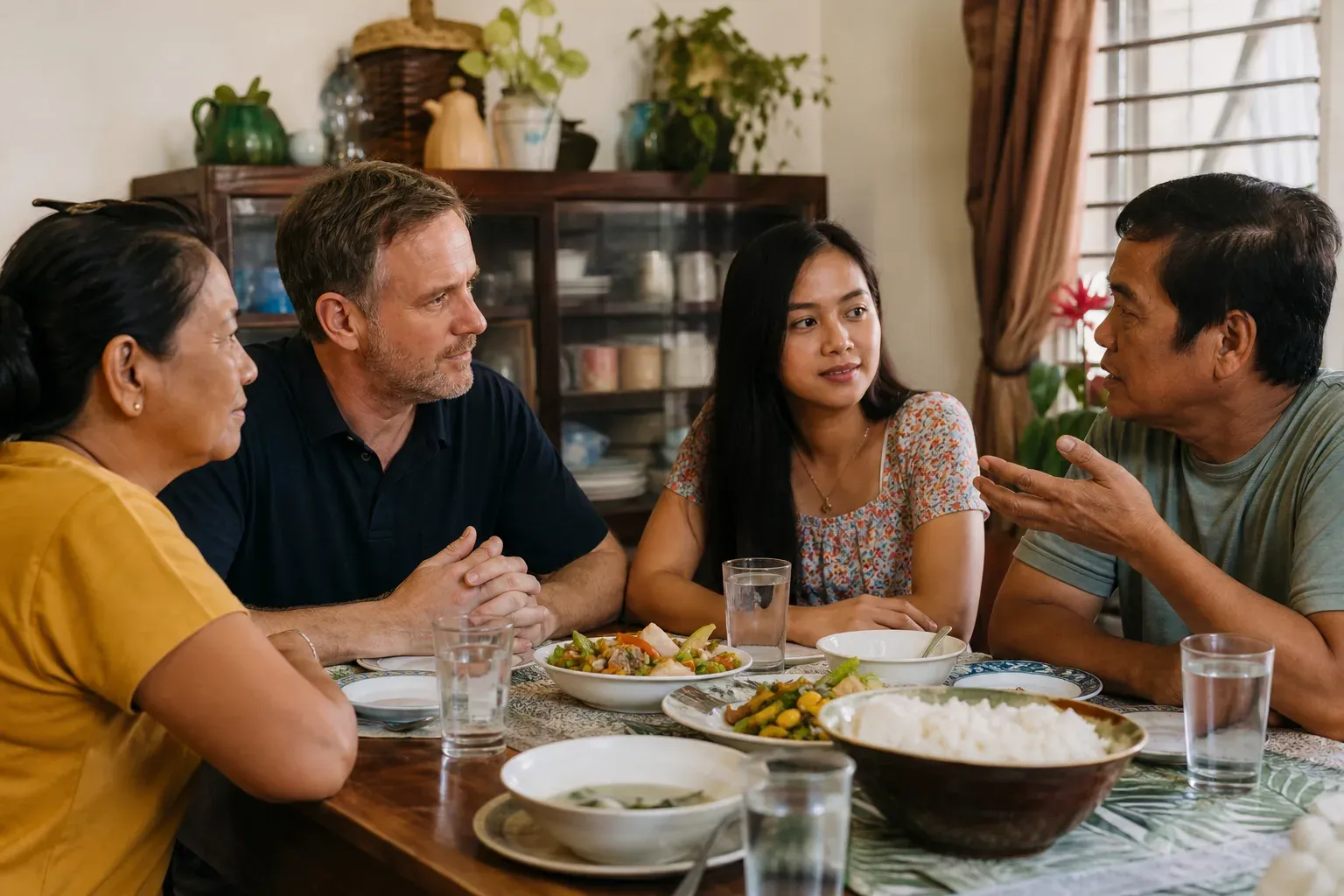
Family is central in many Filipino households, but the details vary widely. Some parents expect to be consulted before an engagement. Others are happy with a warm introduction. Your partner should explain what feels respectful in her family.
Pamamanhikan is a traditional meeting in which the couple and their families discuss the intended marriage. It can be formal or simple, and not every couple follows it. If it matters to your partner, approach it as a conversation between families rather than a performance or a transaction.
Family closeness also needs boundaries. Before marriage, agree on how often relatives will visit, what information stays private, and how requests for financial help will be handled. Respect for family and protection of the marriage can exist together.
Make money expectations specific
Financial ambiguity causes avoidable conflict in any marriage. Cross-border couples may also face travel, document, relocation, and remittance costs.
Each person should disclose income, debt, dependents, and regular commitments. Build a written budget for housing, immigration, travel, emergencies, and family support. If one partner will pause work during relocation, agree on how long that arrangement is expected to last and how both people will retain reasonable financial independence.
Money should never be used to control the relationship. A larger income does not buy decision-making power, and family need does not create an unlimited claim on the household budget.
Verify the legal requirements where you will marry
Marriage rules depend on the place of marriage, nationality, age, and previous marital status. Requirements and appointment procedures can change, so use current government information rather than copying a generic document list.
If you plan to marry in the Philippines:
- Contact the local civil registrar in the city or municipality where you will apply.
- Ask your embassy or consulate what proof it can provide regarding your legal capacity to marry.
- Confirm how birth records, identification, prior divorce or annulment records, translations, and authentication must be presented.
- Allow time for the marriage-license process and any required seminar or waiting period.
- After the ceremony, ask how and when the marriage record can be obtained from the Philippine Statistics Authority.
The U.S. Department of State guidance on marriage abroad explains why local authorities determine validity. Couples from other countries should use the equivalent foreign-affairs and immigration sites for their nationality.
This guide is general information, not legal advice. A local civil registrar, embassy or consulate, and qualified immigration professional can confirm what applies to your case.
Choose the immigration route before the ceremony
Where and when you marry can affect the immigration process. Do not choose a ceremony location based only on convenience and assume the visa will work itself out later.
For U.S. citizens, the two commonly compared paths are:
- K-1 fiancé or fiancée route: the couple intends to marry in the United States after the foreign fiancé or fiancée is admitted. USCIS says the marriage must take place within 90 days of admission.
- Spousal immigrant route: the couple marries first, then the U.S. citizen or permanent resident petitions for the spouse through the applicable process.
Start with the current USCIS K-1 process or USCIS spouse guidance. Fees, forms, evidence, and processing conditions can change. Never rely on a dating blog for a filing deadline or final eligibility decision.
For another destination country, use that government’s official immigration website. Compare the full path, not just the initial visa: work authorization, health requirements, permanent residence, dependents, and travel restrictions may all matter.
Plan for life after relocation
Relocation can produce loneliness, loss of professional identity, homesickness, and dependence even in a healthy marriage. Talk about these risks before the move.
The relocating partner should have access to personal documents, money, transportation, communication, and a support network. The settled partner can help with local systems without controlling every choice. Plan regular contact with family in the Philippines and set a realistic travel budget.
Both people also need room to keep parts of their own culture. You can create shared traditions without asking either partner to disappear into the other person’s life.
Watch for pressure and unresolved risk
Pause marriage planning if either person:
- Avoids live video or in-person meetings
- Changes important identity or relationship details
- Pressures the other person to send money or file documents quickly
- Refuses reasonable financial disclosure
- Uses a visa, pregnancy, religion, or family approval as leverage
- Expects marriage to solve repeated trust problems
A verified profile, family introduction, or long message history is not a substitute for time and consistent behavior. Review how to avoid scams when dating Filipinas and the dating safety guide before making financial or legal commitments.
A practical order of decisions
The simplest sequence is:
- Verify identity and meet in person.
- Spend enough ordinary time together to assess compatibility.
- Agree on location, children, faith, finances, and family boundaries.
- Compare marriage and immigration routes using official sources.
- Confirm the current document list with the relevant authorities.
- Build a budget and timeline with room for delays.
- Plan the ceremony only after the legal and relationship decisions are clear.
Marriage succeeds through shared decisions, not cultural assumptions. If both partners can speak honestly, protect each other’s independence, and handle difficult plans as a team, they have a stronger foundation than any checklist of “Filipina wife traits” could provide.
Related reading
Questions, answered
Frequently asked questions
What should I know before proposing to a Filipina?
Discuss where you would live, finances, support for relatives, children, religion, work, and immigration before proposing. Meet in person and spend enough ordinary time together to judge compatibility. Ask how she wants her family involved instead of assuming one Filipino tradition applies to everyone.
How important is family approval when marrying a Filipina?
Family approval matters in many Filipino relationships, but every family is different. Some couples hold a formal pamamanhikan, while others arrange a simple meeting. Ask your partner what her family expects and agree together on healthy boundaries.
What are the legal requirements for marrying a Filipina?
Requirements depend on where the marriage takes place, each person’s citizenship, age, and marital history. In the Philippines, start with the local civil registrar where you plan to apply and confirm current documentary requirements with your embassy or consulate. Do not rely on an old online checklist.
What visa options are available for bringing a Filipina wife to my country?
Visa paths depend on your country and whether you marry before or after immigration. For the United States, a K-1 is a fiancé or fiancée route and an immigrant spousal visa is used after marriage. Confirm the current process and eligibility on official government websites before filing.
How do we handle cultural differences in a Filipino-Western marriage?
Discuss expectations directly, especially around money, relatives, household roles, conflict, faith, and relocation. Build shared rules rather than expecting either partner to represent or abandon an entire culture.
Is it normal for a Filipina to send money to her family after marriage?
Some Filipinos support parents or relatives, while others do not. Before marriage, disclose income, debt, and existing commitments, then agree on a household budget and a limit that protects your shared goals.