
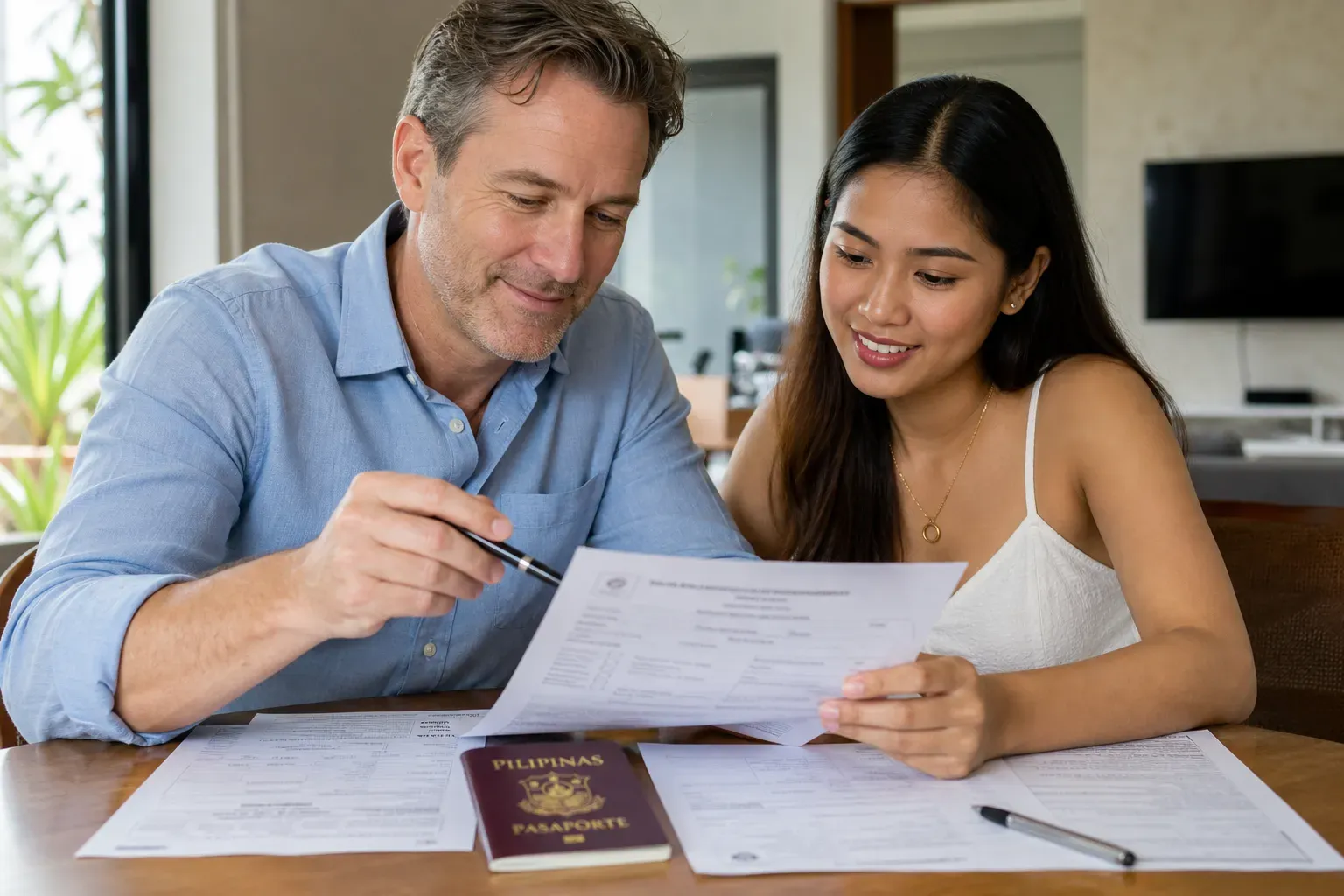
What is the K1 Visa Filipina Process?
The K1 visa Filipina process uses the K-1 nonimmigrant visa, which allows the foreign fiancée of a US citizen to enter the United States for the purpose of getting married. Once the couple marries within 90 days of the fiancée’s arrival, the foreign spouse can apply for Adjustment of Status to become a lawful permanent resident.
For American men in relationships with Filipina women, the K-1 visa is one of the most common paths to bringing a partner to the United States. The Philippines consistently ranks among the top countries of origin for K-1 visa applicants, and the US Embassy in Manila processes a high volume of these cases every year.
This guide walks through the entire K-1 visa process step by step, from eligibility through to the green card. It covers what to expect, what it costs, and where people commonly run into problems.
Important disclaimer: Immigration law changes frequently. Filing fees, processing times, and document requirements can shift without much notice. This guide reflects general information current as of its publication date. Always verify details directly with USCIS and consult an immigration attorney for advice specific to your situation. Nothing in this article constitutes legal advice.
Who qualifies for the K-1 visa?
Before starting the process, confirm that you meet all the basic eligibility requirements. Both the US citizen petitioner and the foreign fiancée must satisfy specific conditions.
US citizen petitioner requirements:
- Must be a US citizen. Lawful permanent residents (green card holders) cannot petition for a K-1 visa.
- Must be legally free to marry. Any prior marriages must have been legally terminated through divorce, annulment, or the death of a former spouse.
- Must intend to marry the fiancée within 90 days of her arrival in the United States.
Filipina fiancée requirements:
- Must be legally free to marry under Philippine law. Since the Philippines does not recognize divorce for Filipino citizens (except in limited cases involving Muslim Filipinos under the Code of Muslim Personal Laws), this generally means she has never been married or has obtained a legal annulment.
- Must have met the US citizen petitioner in person at least once within the two years before the petition is filed.
The in-person meeting requirement is one USCIS takes seriously. You will need to provide evidence: photographs together, passport stamps, boarding passes, hotel receipts, or other documentation showing you were physically in the same place. Video calls do not count.
There are narrow exceptions to the meeting requirement based on cultural customs or extreme hardship, but these are difficult to obtain and rarely granted. For most couples, the straightforward path is to meet in person in the Philippines or elsewhere before filing.
If you are planning your first trip to the Philippines, our first trip guide covers logistics and expectations.
Step 1: File Form I-129F with USCIS
The K-1 visa process begins when the US citizen files Form I-129F, Petition for Alien Fiancé(e), with US Citizenship and Immigration Services. Only the US citizen can file this petition. The Filipina fiancée cannot self-petition.
What to include with the petition:
- Completed Form I-129F
- Filing fee (currently $535, but verify on the USCIS website before filing)
- Proof of US citizenship (passport copy, birth certificate, or naturalization certificate)
- Proof that any prior marriages were legally terminated (divorce decrees, annulment records, or death certificates)
- Evidence of the in-person meeting within the past two years
- Photographs of the couple together
- Evidence of the genuine relationship (correspondence records, chat logs, call logs, travel itineraries, receipts from visits)
- Passport-style photographs of both the petitioner and the fiancée
Package everything carefully. Missing documents are one of the most common reasons for delays. USCIS will issue a Request for Evidence (RFE) if something is missing, which adds weeks or months to the timeline.
Mail the petition to the USCIS lockbox facility designated for I-129F petitions. The correct address depends on your state of residence and can be found on the USCIS website.
Step 2: USCIS processing and approval
After USCIS receives your petition, you will get a receipt notice (Form I-797C) with a case number. Use this number to track your case status online at the USCIS website.
What happens during processing:
- USCIS reviews the petition for completeness and eligibility.
- If anything is missing or unclear, USCIS issues a Request for Evidence (RFE). Respond to RFEs promptly and thoroughly.
- USCIS may also conduct background checks on both parties.
- Once approved, USCIS sends an approval notice (Form I-797B) to the petitioner.
Typical processing time: 6 to 10 months, though it can be shorter or longer depending on USCIS workload, the service center processing your case, and whether any RFEs are issued. Check the USCIS processing times page for current estimates.
There is not much you can do to speed up this stage. Some petitioners file outside the normal process through premium processing, but premium processing is not available for I-129F petitions. The wait is the wait.
Use this time productively. Your fiancée can begin gathering her Philippine documents, and you can both prepare for the next stages.
Step 3: National Visa Center forwards the case to US Embassy Manila
After USCIS approves the I-129F petition, the case is forwarded to the National Visa Center (NVC). The NVC does not process the case in detail. It assigns a case number, collects some initial information, and then forwards the case to the US Embassy in Manila, since that is where your fiancée will attend her visa interview.
What to expect:
- The NVC sends instructions to the petitioner and the fiancée.
- The fiancée receives a case number and instructions to complete Form DS-160 (Online Nonimmigrant Visa Application).
- The NVC stage typically takes 4 to 8 weeks.
Once the case arrives at the US Embassy Manila, the embassy takes over scheduling and processing.
Step 4: Embassy interview preparation and documents
After the US Embassy Manila receives the case, your fiancée will receive a packet of instructions (sometimes called “Packet 3” or an interview appointment letter) detailing what to bring and when to appear.
Documents your fiancée needs to gather:
- Valid Philippine passport
- PSA (Philippine Statistics Authority) birth certificate
- PSA CENOMAR (Certificate of No Marriage) — confirming she has never been married, or evidence of annulment if previously married
- NBI (National Bureau of Investigation) clearance
- Police clearance from any locality where she has lived for six months or more after age 16
- Passport-style photographs meeting US visa photo requirements
- Evidence of the relationship (photos, correspondence, travel records)
- Completed Form DS-160 confirmation page
- Visa application fee payment receipt ($265)
- Any documents specifically requested by the embassy
Documents the US citizen petitioner should prepare:
- Proof of financial ability to support the fiancée. This typically means filing Form I-134, Affidavit of Support, along with recent tax returns, W-2s, pay stubs, and bank statements.
- The income threshold is 100% of the Federal Poverty Guidelines for the household size (the petitioner plus the incoming fiancée, plus any dependents). For a household of two, this is currently around $21,000 to $22,000 annually, though the figure changes each year.
- If your income falls short, a joint sponsor (a US citizen or permanent resident willing to co-sign the financial support) can supplement your application.
Start gathering these documents early. PSA certificates, NBI clearance, and police clearances all have their own processing times, and delays in getting Philippine government documents are common.
Step 5: Medical exam and interview at US Embassy Manila
Medical examination:
Before the interview, your fiancée must complete a medical examination with a physician authorized by the US Embassy. In Manila, the designated clinic is St. Luke’s Medical Center or other panel physicians listed on the embassy website. The exam includes a physical examination, blood tests, chest X-ray, and required vaccinations.
The medical exam typically costs $200 to $300. Schedule it well before the interview date, as the clinic may have its own wait times. The sealed medical results packet goes directly to the embassy — your fiancée should not open it.
The embassy interview:
The interview takes place at the US Embassy in Manila. Your fiancée attends alone. The US citizen petitioner does not attend (and generally cannot be present during the interview).
A consular officer reviews the documents, asks questions about the relationship, and determines whether the visa should be issued. Common questions include:
- How did you meet?
- How long have you been together?
- When and where did you meet in person?
- What are your plans after arriving in the United States?
- Has the petitioner visited the Philippines? How many times?
The interview is typically brief — 10 to 20 minutes in most cases. The consular officer is looking for evidence that the relationship is genuine and that the couple has a real intention to marry. Honest, consistent answers aligned with the documentary evidence are what matters.
After the interview:
- If approved, the embassy will instruct your fiancée on passport submission for visa stamping. The visa is usually issued within a few days to two weeks after the interview.
- If additional documents or evidence are needed, the officer may place the case in “administrative processing,” which can add weeks or months.
- In rare cases, the visa may be denied. The officer must provide a reason, and depending on the grounds, you may be able to address the issue and reapply.
Step 6: Visa issuance and travel to the United States
Once the K-1 visa is stamped in your fiancée’s passport, she has six months to enter the United States. The visa is single-entry, meaning she can only use it once.
Before traveling:
- Book flights. Manila to major US cities is well-served by several airlines.
- Prepare for customs and immigration at the US port of entry. Your fiancée will present her passport with the K-1 visa and the sealed immigrant packet from the embassy. The customs officer at entry will process her admission as a K-1 nonimmigrant.
- Do not open the sealed packet. It gets handed to the border officer.
At the port of entry:
The border officer reviews the documents, asks a few questions, and admits your fiancée. Her I-94 arrival record will reflect K-1 status with an authorized stay of 90 days.
The 90-day clock starts on the day she enters the United States. Not the day the visa was issued. Not the day of the interview. The day of entry.
Step 7: Marriage within 90 days and Adjustment of Status
This is the critical step. You and your fiancée must legally marry within 90 days of her entry into the United States. There are no extensions. If you do not marry within 90 days, she must leave the country.
Getting married in the US:
Marriage requirements vary by state. Most states require a marriage license, which involves appearing together at the county clerk’s office, presenting identification, and paying a fee. Some states have a waiting period between obtaining the license and the ceremony. Research your state’s requirements in advance so there are no surprises.
The ceremony can be civil or religious. What matters legally is that the marriage is valid under the laws of the state where it takes place.
After marriage — Adjustment of Status (Form I-485):
Within the 90-day window (ideally right after the wedding), file Form I-485, Application to Register Permanent Residence or Adjust Status. This is how your now-spouse transitions from K-1 nonimmigrant status to lawful permanent resident (green card holder).
Along with the I-485, you will typically file:
- Form I-864, Affidavit of Support (the binding version, different from the I-134 filed earlier)
- Form I-765, Application for Employment Authorization (so your spouse can work while the I-485 is pending)
- Form I-131, Application for Travel Document (so your spouse can travel outside the US and return while the I-485 is pending)
- Medical exam results (if the previous exam has expired, a new one with a USCIS-designated civil surgeon may be required)
The I-485 filing fee is currently $1,225 and includes biometrics. Your spouse will receive a biometrics appointment notice and, eventually, an interview notice.
Conditional vs. unconditional green card: Because you will have been married for less than two years when the green card is approved, your spouse receives a two-year conditional green card. Before it expires, you must jointly file Form I-751, Petition to Remove Conditions on Residence, to convert it to a ten-year unconditional green card.
Processing times and costs overview
Processing times and fees change regularly. The figures below are approximate ranges to help you plan, not guarantees.
Typical timeline (total): 10 to 16 months from I-129F filing to visa issuance. Add 2 to 4 months for travel and marriage, plus 8 to 14 months for Adjustment of Status processing.
Estimated costs:
| Item | Approximate cost |
|---|---|
| I-129F filing fee | $535 |
| DS-160 visa application fee | $265 |
| Medical exam in Manila | $200–$300 |
| I-485 Adjustment of Status fee | $1,225 |
| Document gathering (PSA, NBI, translations, shipping) | $100–$300 |
| Total (without attorney) | $2,300–$2,600 |
| Immigration attorney (optional) | $1,500–$5,000+ |
These figures do not include travel costs for visits, which are a significant part of the overall expense. For planning travel budgets, see our Philippines vacation budget guide.
Common mistakes and pitfalls
Having seen how this process plays out for many couples, several mistakes come up repeatedly.
Insufficient evidence of the relationship. USCIS and the consular officer want to see that the relationship is genuine. Submitting a thin file with only a few photos and no correspondence records makes the case weaker. Include chat logs, call records, photos from visits, receipts from time spent together, and anything else that demonstrates a real, ongoing relationship.
Missing or expired documents. Philippine government documents like PSA certificates and NBI clearances have validity periods. If your documents expire before they are needed, you will have to get new ones. Build buffer time into your schedule.
Not meeting the income requirement. The I-134 and I-864 financial support requirements trip up petitioners whose income falls below the poverty guidelines. If your income is close to or below the threshold, line up a joint sponsor before you need one.
Opening the sealed medical packet. This sounds minor, but it happens. The sealed packet from the medical exam and the embassy must remain sealed until it is handed to the border officer. Opening it can create problems.
Waiting too long to marry after entry. The 90-day window feels generous until it is not. State marriage license requirements, waiting periods, and scheduling conflicts can eat into the timeline. Start the marriage license process within the first few weeks of arrival.
Not filing Adjustment of Status promptly. After the wedding, file the I-485 package as soon as possible. Delays in filing can leave your spouse in a gray area regarding work authorization and travel.
Underestimating the conditional green card step. Many couples forget about the I-751 filing that comes two years later. Mark it on your calendar well in advance of the conditional green card expiration date.
For guidance on identifying problematic patterns in relationships before you reach the visa stage, read Filipina Dating Red Flags and Avoid Scams When Dating Filipinas.
K-1 fiancé visa vs CR-1 spousal visa: which should you choose?
The K-1 is not the only option. If you and your Filipina partner are already married (or willing to marry before she comes to the US), the CR-1 spousal visa is the alternative path. Each has trade-offs.
Choose the K-1 visa if:
- You want to marry in the United States rather than abroad.
- Speed of getting your partner to the US is the priority. The K-1 process from petition to arrival is generally faster than the CR-1.
- You are comfortable with the additional step of filing Adjustment of Status after arrival.
Choose the CR-1 visa if:
- You are already married or plan to marry in the Philippines (see How to Marry a Filipina for the Philippine marriage process).
- You want your spouse to arrive in the US as a lawful permanent resident from day one, with a green card and work authorization.
- You want to avoid the 90-day marriage deadline and the separate Adjustment of Status filing.
Key differences at a glance:
| Factor | K-1 Fiancé Visa | CR-1 Spousal Visa |
|---|---|---|
| Must be married before filing? | No | Yes |
| Time to US entry | 10–16 months | 12–18+ months |
| Status on arrival | Nonimmigrant (90-day conditional) | Lawful permanent resident |
| Can work on arrival? | No (must file for EAD) | Yes (green card includes work authorization) |
| Additional filing after arrival? | I-485 Adjustment of Status required | No |
| Overall government fees | Higher (petition + AOS fees) | Lower (single process) |
For many couples, the K-1 is the better choice when the relationship is strong and they simply want to start their life in the US as quickly as possible. The CR-1 makes more sense when the couple has already married and values arriving with permanent resident status.
There is no universally “right” answer. Consider your timeline, your financial situation, and whether marrying abroad or in the US matters to you. An immigration attorney can help you weigh the specifics of your case.
Tips for a smooth K-1 visa process
Organize your documents early. Create a checklist of every document both parties need. Start gathering them months before you expect to need them. Philippine government offices can be slow, and documents have expiration dates.
Be thorough with relationship evidence. More is better. Include a range of evidence types: photos, chat screenshots, call logs, travel records, receipts, and a personal statement describing your relationship history.
Respond to RFEs quickly and completely. If USCIS or the embassy requests additional evidence, treat it as urgent. Delayed or incomplete responses are a common cause of case delays.
Prepare for the embassy interview. Your fiancée should be able to describe the relationship clearly and consistently. She should know basic facts about you, your family, where you live, and your shared plans. This is not about memorizing a script — it is about demonstrating a real relationship.
Keep copies of everything. Photocopy or scan every document before submitting it. Keep a complete duplicate of your entire petition package.
Stay informed. Processing times, fees, and requirements change. Check the USCIS website and the US Embassy Manila website periodically for updates.
Maintaining your relationship during the process
The K-1 visa process is long. Months of waiting with bureaucratic uncertainty can strain even strong relationships. This is normal.
Stay connected through regular video calls and messaging. Plan visits when possible — additional visits to the Philippines during the processing period not only maintain the relationship but also provide more evidence of its genuineness.
Be transparent with your fiancée about where things stand in the process. Share receipt notices, status updates, and timelines. The uncertainty is easier to handle together than alone.
For practical strategies on managing the distance, see Long-Distance Relationships with Filipinas.
Official resources
Always verify information against official government sources:
- USCIS — Visas for Fiancé(e)s of US Citizens — the definitive source on K-1 visa eligibility, forms, and filing instructions.
- US Embassy Manila — Immigrant Visas — information specific to visa processing at the Manila embassy.
- Travel.state.gov — The Immigrant Visa Process — overview of the visa process from the State Department.
Related reading
- How to Marry a Filipina — legal steps for marrying in the Philippines, useful if you are considering the CR-1 path or want to understand Philippine marriage requirements.
- Filipina Dating Red Flags — patterns to watch for before committing to a visa process.
- Avoid Scams When Dating Filipinas — protecting yourself from fraud during long-distance relationships.
- Long-Distance Relationships with Filipinas — maintaining a strong connection during the months of visa processing.
Questions, answered
Frequently asked questions
How long does the K-1 visa process take for a Filipina fiancée?
The entire K-1 visa process typically takes 10 to 16 months from filing the I-129F petition to visa issuance. USCIS processing of the petition accounts for most of the wait, usually 6 to 10 months. Embassy processing in Manila adds another 2 to 4 months after that.
How much does the K-1 visa cost in total?
Budget roughly $2,000 to $3,500 for government filing fees, medical exam, document gathering, and translations. The I-129F filing fee is $535, the visa application fee is $265, the medical exam runs $200 to $300, and Adjustment of Status (I-485) after arrival costs $1,225. Additional costs may include document shipping, translations, and attorney fees if you use one.
Do I have to meet my Filipina fiancée in person before filing the K-1 visa?
Yes. USCIS requires that you and your fiancée have met in person at least once within the two years before filing the I-129F petition. You must provide evidence of that meeting, such as photos, boarding passes, passport stamps, or hotel receipts. Limited exceptions exist for cultural or extreme hardship reasons, but they are rarely granted.
Can my Filipina fiancée work in the US on a K-1 visa?
Not immediately. K-1 visa holders can apply for an Employment Authorization Document (EAD) by filing Form I-765 alongside or after the I-485 Adjustment of Status application. The EAD typically takes 3 to 6 months to arrive. Your fiancée cannot legally work until she receives the EAD.
What happens if we do not marry within 90 days of arrival?
If the 90-day period expires without a marriage, the K-1 visa holder must leave the United States. There is no extension. Overstaying creates serious immigration consequences, including bars on future visa applications. If you have doubts about the timeline, consult an immigration attorney before the deadline passes.
Should I choose the K-1 fiancé visa or the CR-1 spousal visa?
The K-1 visa is faster to get your partner to the US but requires marrying within 90 days of arrival and then filing for Adjustment of Status separately. The CR-1 visa requires marrying first, takes longer overall, but your spouse arrives as a permanent resident with a green card. Choose K-1 if speed matters most. Choose CR-1 if you prefer your partner to arrive with full residency status and work authorization.